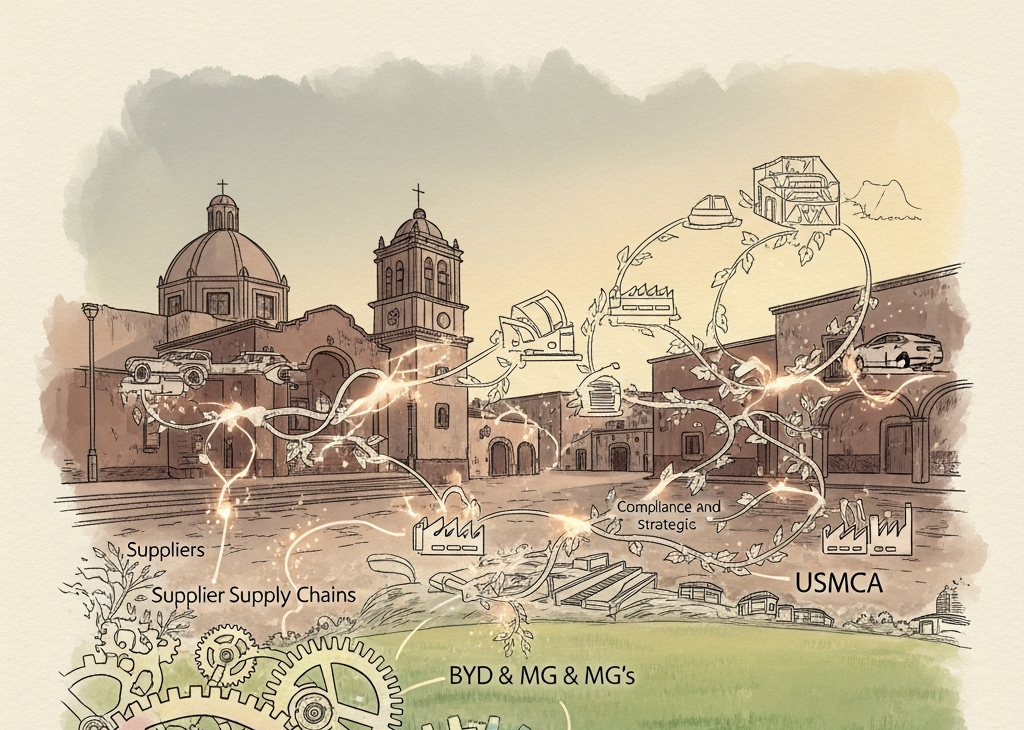
Chinese automotive manufacturers entering Mexico present the most significant greenfield procurement opportunity in North American automotive history. Unlike established OEMs with decades-old supplier networks, companies like BYD in Jalisco and MG Motor in San Luis Potosí must build their entire supply chain from scratch to meet USMCA Rules of Origin requirements. This necessity creates unprecedented access for Mexican suppliers to secure high-volume contracts with rapidly growing manufacturers who need everything from stamped metal components to complex sub-assemblies. Based on our direct advisory work with 23 Chinese automotive enterprises establishing Mexico operations, the procurement transformation happening now will determine which suppliers capture the next decade of automotive growth in North America.
The contrast between traditional automotive procurement and Chinese OEM purchasing patterns reveals both the challenge and the extraordinary opportunity. Where General Motors operates through established portals like Covisint with rigid qualification processes that can take 18-24 months, Chinese manufacturers are implementing more agile procurement strategies driven by their urgent need to achieve local content compliance. This creates a narrow but lucrative window for Mexican suppliers who can demonstrate rapid scale-up capabilities and meet the stringent quality standards required for USMCA qualification.
The USMCA Compliance Imperative: Why Chinese OEMs Must Buy Local
The 75% Regional Value Content requirement for light vehicles under USMCA creates the fundamental market driver that transforms Chinese automotive operations from simple assembly plants to integrated manufacturing ecosystems. For BYD and MG Motor, achieving this threshold requires a strategic shift from importing Complete Knocked-Down (CKD) or Semi Knocked-Down (SKD) kits from Shenzhen to establishing deep local manufacturing partnerships across critical component categories.
Our analysis of successful Chinese automotive compliance strategies reveals that achieving 75% RVC requires local sourcing of high-value components including stamped body panels, die-cast aluminum parts, interior systems, and electronic sub-assemblies. This is not merely an assembly operation – it demands sophisticated local manufacturing capabilities that can meet both cost and quality benchmarks established in Chinese home market operations.
Critical Component Categories for Localization
The highest-impact opportunities for Mexican suppliers center on components that contribute significantly to vehicle value while being technically feasible to produce locally. Based on successful localization case studies, priority categories include:
- Stamped Metal Components: Body panels, structural reinforcements, and chassis components represent 15-20% of vehicle value and are ideal for local production due to shipping cost advantages and USMCA qualification benefits.
- Die-Cast Aluminum Parts: Engine blocks, transmission cases, and structural components offer high value density and significant weight-based shipping cost savings when produced locally.
- Interior Systems: Seats, dashboard assemblies, and door panels provide substantial RVC contribution while leveraging Mexico’s established expertise in automotive interiors.
- Wiring Harnesses and Electronic Sub-assemblies: Critical for USMCA compliance due to high value content and complex Rules of Origin calculations for automotive electronics.
Chinese OEMs face a strategic imperative: either achieve local content compliance through sophisticated supplier partnerships or forfeit the USMCA tariff advantages that make North American production economically viable. This binary choice creates unprecedented leverage for Mexican suppliers who can demonstrate scalable manufacturing capabilities.
BYD’s Greenfield Procurement Strategy: Beyond Traditional Automotive Sourcing
BYD’s approach to supplier development in Jalisco represents a fundamental departure from traditional automotive procurement models. According to industry analysis, BYD represents a “greenfield” opportunity; they need everything from seats to stamped metal, and they need it locally to meet USMCA ROO eventually. This comprehensive sourcing requirement creates opportunities across the entire automotive value chain, from Tier 1 system integrators to Tier 3 component specialists.
The procurement transformation involves multiple strategic dimensions that create distinct competitive advantages for early-stage supplier partners. BYD’s integrated manufacturing model, which encompasses everything from battery cells to final vehicle assembly, requires supplier partners who can integrate into a vertically coordinated production system while maintaining the flexibility to scale rapidly as production volumes increase.
Electric Vehicle Component Specialization
BYD’s electric vehicle focus creates specialized procurement requirements that differ significantly from traditional internal combustion engine vehicles. Key opportunity areas include:
- Battery Pack Components: Thermal management systems, structural housings, and safety systems that require specialized manufacturing capabilities and strict quality certifications.
- Power Electronics Housings: Die-cast aluminum and precision-machined components for inverters, onboard chargers, and DC-DC converters that demand high-precision manufacturing and thermal management properties.
- Lightweight Structural Components: Advanced high-strength steel and aluminum components that reduce vehicle weight while maintaining safety performance, critical for electric vehicle range optimization.
- Charging Infrastructure Components: Connectors, cables, and mounting systems for both AC and DC charging systems that must meet international safety standards.
The procurement process for these specialized components involves technical validation phases that can be completed in 6-8 months for suppliers who demonstrate both manufacturing capability and quality system maturity. This represents a significant time advantage compared to traditional automotive qualification cycles.
Supplier Development and Partnership Models
BYD’s supplier partnership approach emphasizes long-term strategic relationships with suppliers who can grow alongside the company’s expansion plans. This includes joint investment in tooling, shared quality development programs, and coordinated capacity expansion that aligns with BYD’s production scaling timeline.
Successful supplier partnerships typically involve three-phase development programs: initial prototype and validation (3-6 months), pilot production and quality certification (6-12 months), and full-scale production with continuous improvement processes (ongoing). Suppliers who demonstrate excellence in early phases often receive expanded component assignments and preferred status for new program awards.
MG Motor’s Latin American Hub Strategy: Engineering-Driven Procurement
MG Motor’s strategy extends beyond traditional automotive assembly to establish Mexico as a comprehensive manufacturing and development hub for Latin America. MG Motor announces plant and R&D Center in Mexico for Latin America, signaling an investment approach that prioritizes local engineering capabilities and market-specific product development over simple assembly operations.
This R&D-centered approach creates procurement opportunities that extend beyond traditional component supply to include engineering services, design development, and local adaptation capabilities. The establishment of a dedicated R&D center indicates MG’s intention to develop Latin America-specific vehicle variants, which requires deep collaboration with local suppliers who can support both product development and manufacturing scale-up.
Innovation Partnership Opportunities
The R&D center strategy creates several high-value partnership categories for Mexican suppliers:
- Co-Development Programs: Joint development of components specifically optimized for Latin American market conditions, including climate adaptation, road condition optimization, and cost structure alignment.
- Local Engineering Support: Design and testing services for component localization, including material substitution, manufacturing process optimization, and quality validation.
- Prototype and Low-Volume Production: Rapid prototyping and small-batch manufacturing capabilities to support R&D programs and market testing initiatives.
- Testing and Validation Services: Local testing facilities and validation capabilities for component performance under Mexican and Latin American operating conditions.
These innovation partnerships typically involve higher margins and longer-term contracts compared to traditional supply relationships, as they require specialized capabilities and close collaboration with OEM engineering teams.
Regional Hub Implications for Supplier Strategy
MG’s positioning of Mexico as a regional hub creates supply chain opportunities that extend beyond the Mexican domestic market. Suppliers who establish successful partnerships with MG in Mexico gain potential access to broader Latin American markets as the company expands its regional operations.
This regional strategy requires suppliers to develop capabilities that support multi-country operations, including logistics coordination, regulatory compliance across different markets, and currency management for cross-border transactions. Suppliers who can demonstrate these capabilities gain significant competitive advantages in partnership discussions.
Procurement Process Transformation: From Covisint to Direct Engagement
The contrast between established automotive procurement systems like General Motors’ Covisint portal and the direct engagement models used by Chinese OEMs reveals fundamental differences in supplier access and relationship development. While traditional systems emphasize standardized processes and extensive documentation, Chinese manufacturers are implementing more agile approaches that prioritize rapid qualification and direct communication.
This transformation creates both opportunities and challenges for Mexican suppliers. The reduced bureaucratic overhead enables faster market entry, but requires suppliers to develop direct relationship management capabilities and demonstrate manufacturing competency through hands-on validation rather than paper-based qualification systems.
Direct Engagement Advantages
Chinese OEM procurement models offer several strategic advantages for qualified suppliers:
- Faster Decision Cycles: Direct communication with procurement teams reduces qualification timelines from 18-24 months to 6-9 months for technically capable suppliers.
- Flexible Partnership Structures: Willingness to consider joint ventures, technology sharing, and co-investment arrangements that create deeper strategic relationships.
- Volume Growth Potential: Rapid production scaling creates opportunities for suppliers to grow alongside OEM expansion rather than competing for fixed market share.
- Technology Transfer Opportunities: Access to advanced manufacturing processes and quality systems developed in Chinese operations.
However, these advantages require suppliers to develop new capabilities in relationship management, cultural communication, and technical validation that may differ from traditional automotive industry practices.
Supplier Qualification Requirements
While the procurement process may be more direct, qualification requirements remain stringent and focus on demonstrable manufacturing capability rather than paperwork compliance. Key qualification areas include:
- Manufacturing Capability Demonstration: Physical plant visits, production trials, and quality system audits that verify actual production capability rather than theoretical capacity.
- Financial Stability Validation: Demonstrated ability to invest in tooling, maintain working capital, and scale operations to meet production requirements.
- Technical Competency Verification: Design review participation, problem-solving capability, and continuous improvement track record in similar manufacturing environments.
- Cultural Integration Assessment: Communication effectiveness, project management capability, and alignment with Chinese business practices and expectations.
Suppliers who excel in these areas often receive accelerated qualification and expanded partnership opportunities as Chinese OEMs prioritize relationship depth over supplier base breadth.
INA and Industry Association Role in Supplier Connection
The Industria Nacional de Autopartes (INA) plays a critical role in facilitating connections between Mexican suppliers and Chinese OEMs through organized “Supplier Days” and “Encuentros de Negocios” specifically designed for new market entrants. These events provide structured opportunities for suppliers to present capabilities directly to OEM procurement teams while demonstrating industry credibility through INA membership and participation.
INA’s approach to Chinese OEM integration recognizes the unique needs of manufacturers who lack established supplier networks in Mexico. The association’s events typically feature capability presentations, plant tours, and one-on-one meetings that enable efficient supplier discovery and initial qualification discussions.
Strategic Event Participation
Maximizing value from INA-organized supplier events requires strategic preparation and targeted participation:
- Capability Portfolio Development: Comprehensive presentation materials that demonstrate manufacturing capability, quality certifications, and scalability potential specific to Chinese OEM requirements.
- Cultural Preparation: Understanding of Chinese business practices, decision-making processes, and relationship development expectations to facilitate effective communication.
- Technical Documentation: Detailed process capabilities, quality systems documentation, and reference customer information that supports rapid qualification discussions.
- Partnership Proposals: Specific collaboration models, investment sharing arrangements, and growth partnership structures that align with Chinese OEM strategic objectives.
Suppliers who demonstrate both technical competency and cultural understanding often receive follow-up plant visits and accelerated qualification processes following successful event participation.
Beyond Traditional Supplier Events
The most successful supplier connections often occur through multi-stage engagement processes that extend beyond single events. This includes:
- Technical Seminars: Deep-dive presentations on specific manufacturing processes, quality systems, or technology capabilities that demonstrate expertise in relevant component categories.
- Plant Visit Programs: Coordinated facility tours that showcase actual manufacturing capability and provide opportunities for detailed technical discussions.
- Joint Development Workshops: Collaborative sessions focused on specific component requirements or cost optimization opportunities that demonstrate problem-solving capability.
- Industry Conference Participation: Strategic presence at automotive industry events where Chinese OEM executives participate in panel discussions or networking activities.
These multi-touch engagement strategies create deeper relationships and more comprehensive evaluation opportunities compared to single-event interactions.
Validation Framework: CKD/SKD vs. Local Manufacturing Reality
Determining whether Chinese OEMs are genuinely localizing manufacturing or simply assembling imported kits requires systematic analysis of their operational structure, supplier relationships, and USMCA compliance strategy. This validation is critical for suppliers to understand the true scope and sustainability of procurement opportunities.
The transition from CKD/SKD assembly to integrated manufacturing typically occurs in phases, with early operations focusing on final assembly while gradually adding local content through strategic supplier partnerships. Understanding this evolution timeline helps suppliers position for maximum opportunity capture.
Manufacturing Depth Indicators
Several operational indicators distinguish genuine manufacturing localization from simple assembly operations:
- Tooling Investment: Significant capital investment in stamping dies, casting molds, and specialized production equipment indicates commitment to local manufacturing rather than temporary assembly operations.
- Supplier Development Programs: Active engagement in supplier capability development, quality system implementation, and technology transfer suggests long-term local manufacturing commitment.
- Engineering Resources: Local engineering staff, product development capabilities, and technical support infrastructure demonstrate commitment beyond simple assembly operations.
- Supply Chain Integration: Direct contracts with raw material suppliers, logistics optimization for local sourcing, and inventory management systems aligned with local production schedules.
Chinese OEMs demonstrating these characteristics represent the highest-value partnership opportunities for Mexican suppliers, as they indicate sustainable long-term demand for locally manufactured components.
USMCA Compliance Verification
Validating genuine USMCA compliance requires understanding the specific content calculations and sourcing strategies employed by Chinese OEMs:
- Value Content Analysis: Detailed understanding of how specific components contribute to the 75% Regional Value Content requirement and which components offer the highest compliance leverage.
- Supply Chain Traceability: Documentation systems that track component origin, value addition, and content qualification to ensure USMCA compliance sustainability.
- Regulatory Strategy Alignment: Coordination with legal and regulatory experts who specialize in USMCA automotive provisions and can validate compliance strategies.
- Competitive Benchmarking: Analysis of how other international OEMs achieve USMCA compliance and identification of best practices that Chinese manufacturers are likely to adopt.
Suppliers who understand these compliance requirements can position themselves as strategic partners rather than simple component providers, creating opportunities for deeper relationships and expanded business scope.
Your Mexico Market Entry Strategy: Practical Implementation Framework
Successfully capturing Chinese OEM procurement opportunities requires a systematic approach that addresses both the technical and relationship aspects of supplier development. The implementation framework must account for the unique characteristics of Chinese business culture while demonstrating the manufacturing excellence and scalability that these rapidly growing companies require.
The strategic approach begins with comprehensive capability assessment and competitive positioning, followed by targeted relationship development and systematic qualification process management. Success requires sustained commitment over 12-18 months as relationships develop and technical validation progresses through multiple stages.
Phase 1: Strategic Preparation and Positioning (Months 1-3)
Foundation development focuses on capability documentation, competitive analysis, and cultural preparation:
- Capability Documentation: Comprehensive portfolio development including manufacturing processes, quality certifications, scalability analysis, and reference customer performance data specifically relevant to Chinese OEM requirements.
- Competitive Intelligence: Analysis of current Chinese OEM supplier bases, identification of supply gaps, and assessment of competitive positioning relative to existing suppliers and potential competitors.
- Cultural Training: Team development in Chinese business practices, communication styles, and relationship development expectations to ensure effective engagement throughout the qualification process.
- Financial Preparation: Working capital planning, tooling investment capacity assessment, and partnership structure development to support rapid scaling if partnerships are secured.
Phase 2: Market Entry and Relationship Development (Months 4-9)
Active engagement with Chinese OEMs through multiple channels and systematic relationship building:
- INA Event Participation: Strategic participation in Supplier Days and industry events with targeted follow-up and relationship development activities.
- Direct Outreach: Systematic contact with procurement departments, technical teams, and senior management through professional networks and industry connections.
- Capability Demonstrations: Plant visits, technical presentations, and prototype development programs that showcase manufacturing competency and problem-solving capability.
- Partnership Development: Exploration of joint venture opportunities, technology sharing arrangements, and co-investment structures that create deeper strategic relationships.
Phase 3: Qualification and Contract Negotiation (Months 10-18)
Technical validation, commercial negotiation, and partnership finalization:
- Technical Qualification: Completion of quality audits, process validation, and prototype approval processes that demonstrate manufacturing readiness.
- Commercial Negotiation: Pricing discussions, contract terms development, and partnership structure finalization that ensures sustainable profitability and growth potential.
- Operational Integration: Supply chain integration, communication system establishment, and project management process development to support ongoing partnership success.
- Continuous Improvement: Implementation of performance measurement systems, cost reduction programs, and capability expansion initiatives that ensure long-term partnership value.
Success in this framework requires consistent execution across all phases while maintaining flexibility to adapt to specific OEM requirements and cultural preferences. The investment in relationship development and technical validation typically generates returns through multi-year contracts and expanded partnership opportunities as Chinese OEMs grow their Mexico operations.
Key Implementation Priorities for Chinese OEM Supplier Success: • Develop comprehensive manufacturing capability documentation with specific focus on USMCA compliance contribution • Invest in cultural training and relationship development capabilities to navigate Chinese business practices effectively • Participate strategically in INA supplier events while building direct relationships through multiple engagement channels • Validate genuine manufacturing localization vs. assembly operations to ensure sustainable partnership opportunities
中文金融观点: 中国汽车制造商在墨西哥的采购转型为当地供应商创造了前所未有的资本配置机会。通过战略性供应商伙伴关系和USMCA合规要求驱动的本地化制造,投资者可实现长期稳定的收益率和市场增长潜力。
